

The Best SMM Panel For Resellers is one you can evaluate honestly: clear service descriptions, understandable prices, trackable orders, and terms you can explain to customers. If you're starting in India, the first job is checking whether each service makes business sense after support time, fees, and possible refunds.
A low entry price can help you explore a catalogue. It doesn't tell you what you'll earn, how an order will behave, or whether a service fits your customer's expectations.
This guide walks through those decisions using the starting prices supplied by IndianSMM, worked examples, and a practical launch checklist. You can explore the IndianSMM website alongside it, then use the worksheet below to compare individual services.
Key takeaways
- IndianSMM supplied starting prices from ₹0.07 to ₹55 across five Instagram service categories; the quantity basis needs confirmation.
- Compare full order costs and written terms before quoting customers.
- Keep margin, markup, and available cash separate.
- Check API documentation before automating orders, and explain platform risks honestly.
- How do you choose the Best SMM Panel For Resellers?
- What are IndianSMM's starting prices?
- How do you price orders without confusing revenue and profit?
- What should you verify in an SMM panel with API access?
- How should you manage orders, refills, and customer support?
- What risks and alternatives should you explain to customers?
- How can you launch a reseller offer in seven days?
- Frequently asked questions
- Choose your first service with the numbers in front of you
How do you choose the Best SMM Panel For Resellers?
Choose a panel by checking the services you'll actually sell, then testing whether its ordering process and terms suit your business. The best reseller SMM panel for a small manual operation may differ from one suited to a developer managing automated orders. Begin with your customer needs, budget, and ability to handle problems.
An SMM panel is a storefront for ordering social media services. A reseller buys a service and offers it to a customer, taking responsibility for the description, price, communication, and any promises made during the sale.
That last part matters. Your customer deals with you, even when a separate supplier handles fulfilment.
Compare service IDs, not just panel names
Two Instagram follower listings can have different minimum quantities, delivery notes, refill terms, or account requirements. Treat each service ID as a separate product until its description proves otherwise.
Avoid building your offer around words such as “premium” or “high quality” alone. Ask what those labels mean in measurable terms, and keep a copy of the answer with your product notes.
Start with a narrow shortlist. Five clearly understood services are easier to manage than a large catalogue copied into your store without review.
Build a service selection worksheet
Use this table when reading a listing or contacting support. A blank field means you still have a question to resolve before selling that service.
| Item to record | What you need to know | Why it affects your business |
|---|---|---|
| Service ID and name | The exact listing you're purchasing | Similar names can hide different terms |
| Price basis | Cost per stated quantity and currency | A headline rate alone cannot price an order |
| Minimum and maximum | Accepted order quantities | Your package must fit the permitted range |
| Target requirements | Profile, post, reel, or another URL type | An incorrect link may prevent fulfilment |
| Start and completion notes | Published estimates and limitations | Customers need realistic expectations |
| Refill terms | Eligibility, window, exclusions, process | A refill is conditional, not automatic insurance |
| Cancellation and refunds | When requests are accepted | Your customer policy must account for restrictions |
| Support route | Where to submit an order query | You need a repeatable escalation process |
Save the listing date too. If a supplier changes a description later, you need to know what you reviewed when accepting the customer's order.
Separate Indian billing from Indian audience claims
An Indian SMM panel for resellers may be convenient for local buyers, but its location doesn't establish where delivered accounts originate. Currency, support hours, payment methods, and audience geography are separate checks.
If a customer asks for Indian followers, look for an explicit geographic description and evidence supporting it. Don't infer country, language, interests, or buying intent from the panel's name.
The same applies to the search phrase “Best SMM Panel India.” Treat it as the beginning of your comparison, then verify the details that matter to your actual orders.
What are IndianSMM's starting prices?
IndianSMM supplied the following starting prices for five Instagram service categories. These are advertised entry points for this guide, with no confirmed quantity basis; they aren't a completed customer quote. Check the current service listing, selected quantity, and payable amount before calculating a resale price or accepting payment.
| Service category | Supplied starting price | Confirm before quoting |
|---|---|---|
| Instagram Followers | ₹30 | Quantity basis, service ID, account description, refill terms |
| Instagram Likes | ₹2 | Quantity basis, eligible content, minimum order |
| Instagram Views | ₹0.07 | Quantity basis, content format, view definition |
| Instagram Share | ₹0.60 | Quantity basis, supported content, service description |
| Instagram RePost | ₹55 | Quantity basis, meaning of repost, eligible content |
Pricing note: These figures came from IndianSMM's supplied brief. The public catalogue labels its price column per 1,000, but these promotional amounts have not been matched to specific service IDs. Confirm the exact offer, quantity and checkout total; live listings may differ.
Use the current Instagram service catalogue to check the exact listing. Record the amount shown for your chosen quantity rather than copying a category's smallest starting price into your own store.
Why the quantity basis changes everything
Suppose one listing quotes a price for 100 units and another quotes a price for 1,000 units. You cannot compare the two displayed numbers directly, even if their names look similar.
A fair comparison uses the same quantity, the same type of deliverable, and similar terms. Otherwise, the apparently cheaper option may simply describe a smaller package or a different service.
Don't combine the five starting prices into an Instagram bundle yet. Each category could use a different rate basis or require a different target link.
What should your customer see?
Your customer-facing product page should state the selected quantity, total price, eligible content, and relevant limitations. Include estimated timing only when it comes from the service description, and label estimates clearly.
Avoid promising sales, leads, reach, or an algorithm benefit simply because a product delivers a visible metric. A purchase of likes or followers does not establish genuine interest in the customer's business.
For repost services, explain exactly what the listing means by “repost.” Don't leave customers guessing whether it refers to a specific platform feature, an action, or publication elsewhere.
How do you price orders without confusing revenue and profit?
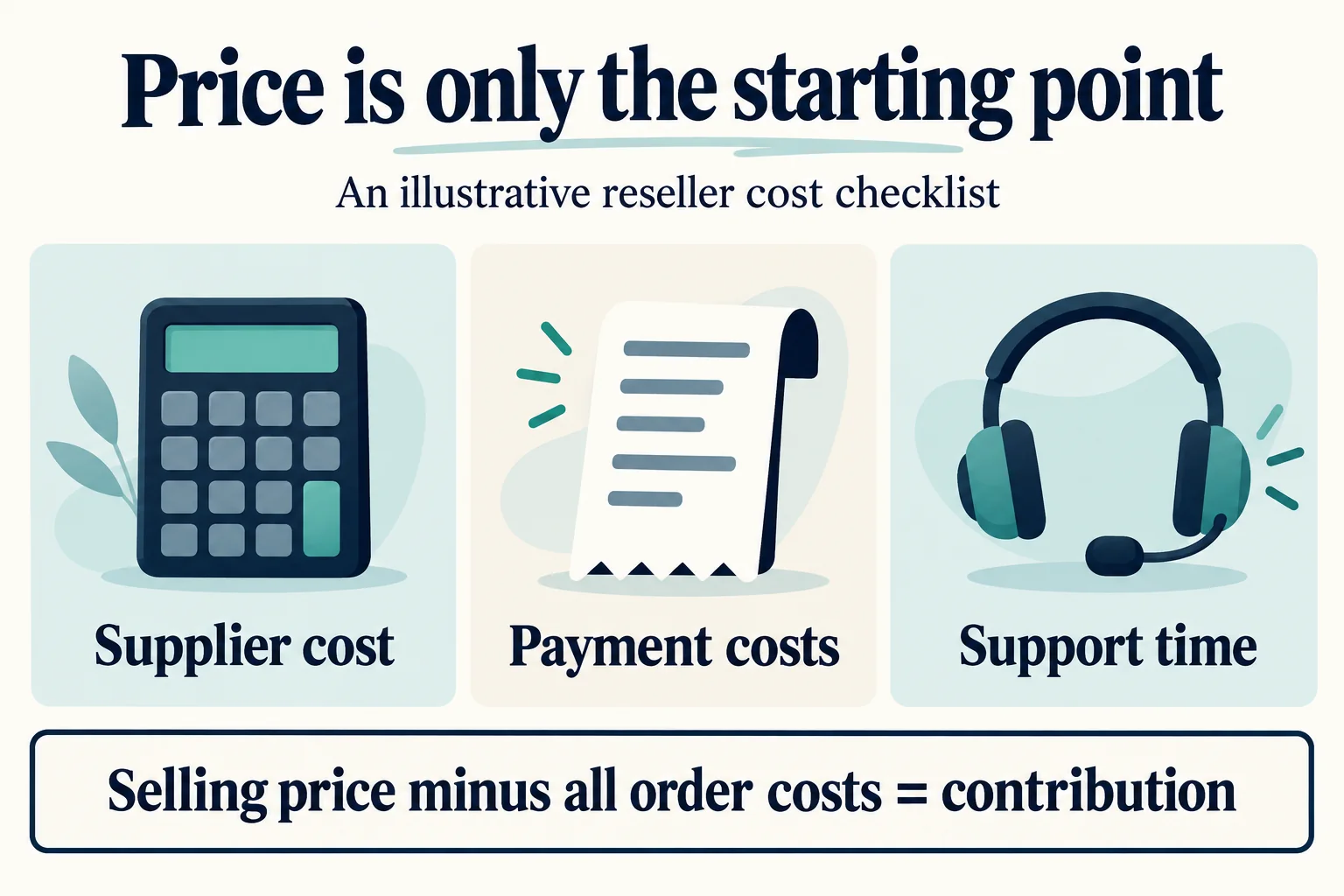
Price an order using its full variable cost, then calculate what remains to cover overhead and pay you. The worked example below uses invented amounts solely to explain the arithmetic; none of these costs or selling prices represent an IndianSMM quote, a typical industry margin, or a promised result.
Imagine a package with a confirmed supplier cost of ₹40. You choose a selling price of ₹100 and budget ₹5 for payment costs, ₹10 for support time, and ₹5 as a planning allowance for problems.
| Hypothetical order calculation | Amount |
|---|---|
| Customer selling price | ₹100 |
| Supplier cost | −₹40 |
| Payment costs | −₹5 |
| Support time allocation | −₹10 |
| Planning allowance for problems | −₹5 |
| Contribution remaining | ₹40 |
This leaves ₹40 towards fixed business costs and owner earnings. It's a planning calculation, not a formal accounting statement; actual fees, tax treatment, refunds, and support time can differ.
Markup and contribution margin answer different questions
Markup compares the selling price with a chosen cost base. Using only the ₹40 supplier cost above, the supplier-cost markup is (₹100 − ₹40) ÷ ₹40 × 100 = 150%.
Contribution margin compares the amount left after planned variable costs with revenue. Here it is ₹40 ÷ ₹100 × 100 = 40%.
Neither figure is net profit. Website costs, subscriptions, bookkeeping, and other overhead still need to be covered.
An affordable SMM panel for resellers should be evaluated against the cost of a resolved order. A small supplier saving can disappear if it creates more support work than your selling price can cover.
Work backwards from a margin target
Suppose your planned variable costs total ₹60 and you want a 40% contribution margin. The calculation is ₹60 ÷ (1 − 0.40) = ₹100.
That formula gives you a proposed price to evaluate, not evidence that customers will buy. Compare it with the value of your service, your market, and the work involved in handling each order.
If the price doesn't make sense, change the package, reduce avoidable work, or skip the service. Quietly removing your support allowance from the spreadsheet doesn't remove the work from your day.
Keep a cash buffer separate from your margin
A supplier balance is money committed to future purchasing. It may not be available for paying a customer refund, and its withdrawal conditions need checking.
Start with a deposit you can justify from a limited order plan. Keep enough separate cash for customer issues instead of depositing every rupee you receive into a panel account.
Review your figures after actual orders. Replace estimated support time and problem allowances with your own records while keeping individual customer information private.
What should you verify in an SMM panel with API access?
An SMM panel with API access can help software submit orders and retrieve their status. IndianSMM's API documentation lists service discovery, order creation, status checks, refill requests, refill status, and balance checks. Confirm how these functions apply to your selected services before connecting a store or promising automation.
The documented endpoint is https://indiansmm.xyz/api/v2, using POST requests and JSON responses. Sample responses illustrate the format; their prices and currencies should not be treated as a live quotation.
Manual ordering is a reasonable starting point while you learn a service. Automating an unclear process can multiply mistakes faster than it saves time.
Read the API documentation with your developer
Ask your developer to document what the API actually supports. At minimum, your integration plan should answer these questions:
- How does authentication work, and where will credentials be stored?
- How are service IDs, prices, currencies, and availability retrieved?
- Which fields are required to submit an order?
- What response proves that the supplier accepted it?
- How are status, remaining quantity, and charges reported?
- Are refill and cancellation requests supported for this service?
- What are the documented request limits and error responses?
Keep the supplier API key on your server. Customers shouldn't see it in a browser page, public repository, screenshot, or shared support message.
Use a small permitted test order or a documented test environment if one exists. Verify the whole sequence before enabling customer orders.
Prevent duplicate orders when a request times out
A timeout doesn't necessarily mean the supplier rejected the order. It may mean your software stopped waiting before the response arrived.
Automatically repeating an uncertain order request can create a second purchase. Your integration should use documented duplicate-prevention features where available, or pause uncertain submissions for reconciliation before retrying.
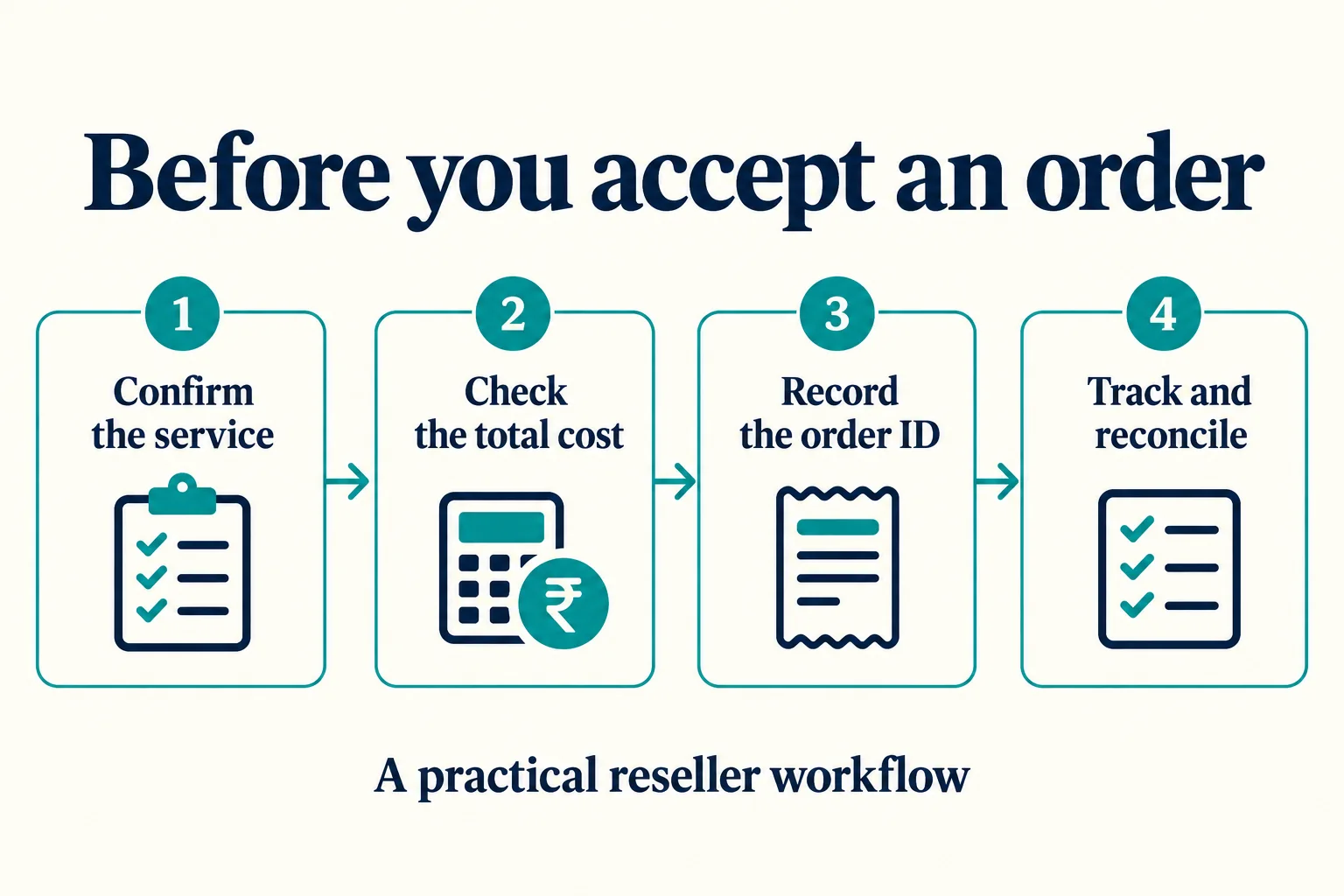
Give every customer purchase your own unique reference. Store the request time, service ID, quantity, supplier response, and supplier order ID when available.
If the API doesn't provide a reliable way to resolve an uncertain submission, make that a manual review step. A clear exception queue is better than an invisible duplicate charge.
Handle price changes before checkout
A service price can change between importing a catalogue and placing an order. Decide how long a customer quote remains valid, and check the current supplier cost before accepting the sale.
If a change makes a package unprofitable, pause it or update its price for future purchases. Don't silently switch an existing order to a different service with different terms.
Also check currency handling. A value stored as a number without its currency and quantity basis is incomplete pricing data.
How should you manage orders, refills, and customer support?
Use one order record to connect the customer's purchase with the supplier's service ID, terms, charge, and status. A reliable SMM panel for resellers should be judged through documented handling of real orders, but your own records matter too. They help you explain delays and resolve questions without guessing.
Check the order before submitting it
Confirm that the link points to the correct profile or content. Check any visibility requirements, quantity limits, and restrictions listed for the selected service.
Record an appropriate starting count where it helps you review delivery. A public count may also change because of unrelated activity, so don't treat every movement as proof of supplier fulfilment.
Avoid overlapping orders to the same target when the provider's rules prohibit them or when overlap would make tracking unreliable. Keep the customer informed if an existing order must finish first.
Explain refill terms before the sale
A refill policy may allow replacement of a qualifying drop within a stated period. It doesn't automatically mean lifetime maintenance, cash refunds, or permanent retention.
Copy the actual eligibility rules into your internal notes. Then explain the relevant customer conditions in plain English without expanding the promise.
For example, ask whether eligibility depends on account visibility, an unchanged username, a minimum drop, or avoiding simultaneous orders. These are questions to check, not assumptions about IndianSMM's policies.
Reconcile partial delivery and refunds separately
Consider another hypothetical order: a customer pays ₹100, the supplier charges ₹50, and the supplier later credits ₹20 for incomplete delivery. Your net supplier cost becomes ₹30.
If you separately refund the customer ₹30, your net customer receipts become ₹70. The difference is ₹40 before other costs, and the supplier credit may remain in your panel balance.
Supplier credits and customer refunds belong in separate records because they don't necessarily match in amount or timing. A status marked “partial” isn't enough information to determine what you owe a customer.
Agree on your customer policy before taking orders. Use the actual purchased package, agreed terms, and applicable obligations when deciding how to resolve a problem.
Send updates that answer the next question
A useful update states what is known, what you've done, and when you'll check again. Avoid inventing a completion time because a customer asks for one.
You might write: “Your order is still processing. I've submitted the order reference for review and will update you tomorrow, even if there isn't a new completion estimate.”
Only promise that update if you can provide it. Save the supplier ticket reference beside the order so another team member can follow the same conversation.
What risks and alternatives should you explain to customers?
Customers should understand what they're buying and what it cannot establish. Paid engagement is not evidence of genuine audience interest, and platform rules can restrict artificial engagement. Review the current rules for each platform before offering a service, then make those limits part of your product description and sales conversation.
In its 2019 article Preventing Inauthentic Behavior on Instagram, Meta states that services selling fake likes, views, and followers violate its rules and describes removing inauthentic activity. Don't describe a panel service as platform-approved, risk-free, or a guaranteed route to account growth.
Avoid selling a follower count as an audience of likely buyers. A business looking for enquiries needs a plan that connects content, offers, distribution, and measurement to that goal.
Match your offer to the customer's actual goal
Ask what success means before recommending a package. Is the customer trying to create better content, reach local prospects, understand their audience, or improve response handling?
Those goals may be better served by content production, profile improvements, community management, creator partnerships, or advertising through official platform tools. These alternatives still require work and don't guarantee results.
If a customer requests a panel service, explain its stated deliverable accurately. Never present purchased activity as independent customer endorsement or fabricate testimonials to support your sale.
Protect the information you collect
Collect only the details needed to process and support the order. Don't ask for a social account password when the service can be evaluated and ordered using an appropriate public link.
Limit access to customer records, hide credentials in screenshots, and avoid sharing entire order exports when one reference will answer a support question. If a supplier requests sensitive access unexpectedly, stop and review the request before proceeding.
Trust depends on these ordinary decisions. A customer should be able to understand the purchase without needing to decode your supplier's technical notes.
How can you launch a reseller offer in seven days?
Use seven days as a preparation schedule, not an income promise. The aim is to finish with a small, understood catalogue, clear customer terms, and a working order process. If a service description or test raises unanswered questions, pause that item instead of rushing it into your shop.
Day 1: Define one customer group
Choose the type of customer you want to serve and the questions they commonly ask. Write a short description of their goals, budget constraints, and likely support needs.
Decide which services you're equipped to explain honestly. You don't need to offer every product that appears in a supplier catalogue.
Day 2: Complete the service worksheet
Review a small shortlist and fill in each field from the earlier table. Ask support about missing information and save the replies.
For IndianSMM, resolve the quantity basis behind the supplied starting rates first. Until then, keep those figures out of any package cost calculation.
Day 3: Build your pricing sheet
Enter supplier costs, payment costs, support allowances, and proposed selling prices. Include an adverse scenario with extra support work or a customer refund.
Check whether you still want to sell the package under that scenario. If the numbers require every order to be effortless, the price needs more thought.
Day 4: Review a permitted small order
Where appropriate, place a small order after reviewing platform rules and service conditions. Record the submission, response, status changes, and any support contact.
One order only tells you what happened in that instance. Don't turn a single successful result into a public claim of guaranteed speed or consistent retention.
Day 5: Write your product and support pages
Describe quantity, target requirements, estimates, refill conditions, and your refund process. Make the customer-facing wording consistent with what you've verified.
Prepare brief responses for common situations: an incorrect URL, an order still processing, an uncertain submission, and a refill request. Check that each response offers a real next step.
Day 6: Test your checkout and records
Walk through the buying process and check the total price before payment. Confirm that your records connect the customer reference with the supplier order.
If you're using an API, test documented error handling and price updates too. Keep uncertain cases visible rather than marking them complete automatically.
Day 7: Start with a manageable order limit
Accept only as much work as you can track and support. Review each completed order's contribution and time spent before increasing volume.
An SMM reseller panel India search may help you find suppliers, but a sound launch depends on this small operating routine. Expand when your records justify it.
Frequently asked questions
The questions below cover common decisions when choosing an SMM panel for reselling. Use the answers as a starting point, then check the terms of the exact service you plan to buy. A category name or promotional headline cannot replace a confirmed quantity, total price, and written description.
Which SMM panel is best for a beginner reseller in India?
Choose one whose service descriptions, price units, order records, and support process you can understand. IndianSMM can be evaluated using the worksheet in this guide, but no universal winner is established here. Start with a small shortlist and verify the conditions before building a customer offer around it.
Are IndianSMM's listed starting prices per 1,000?
The public catalogue labels its price column per 1,000. However, the supplied starting prices have not been matched to specific service IDs, and visible listings can differ. Confirm the exact offer, quantity basis and final order total before treating a promotional starting price as a per-1,000 quotation.
Do I need API access to start reselling?
You can begin with manual ordering if it suits your workload and the panel's process. API access becomes useful when the saved work justifies integration and maintenance. Verify the documentation, credentials handling, duplicate-order prevention, and status reporting before relying on software to place customer orders.
Can an SMM service guarantee sales or organic growth?
A delivered engagement metric cannot establish genuine interest, future reach, or sales. Don't promise those outcomes as part of a panel order. Customers seeking business results should also consider content quality, official advertising, creator partnerships, and conversion tracking, with expectations tied to the work actually being purchased.
How much money should a new reseller deposit?
Base the deposit on a limited, costed order plan and the supplier's funding terms. Keep customer refund money separately accessible, and don't assume unused panel credit can be withdrawn. Begin with an amount you can justify from verified service costs, then review actual orders before committing more funds.
Choose your first service with the numbers in front of you
Start with one service you can describe accurately, price sensibly, and support consistently. Check its quantity basis and terms, calculate the full cost, and write down how you'll handle delays or incomplete delivery before accepting an order.
The IndianSMM services page is the next place to apply that checklist. Compare the current listings with the starting-price table above, resolve missing details, and build your first package around a verified service rather than an attractive headline.
About this guide: Prepared for IndianSMM using the supplied pricing brief, public API documentation and clearly labelled illustrative calculations. This is a supplier-published guide, not an independent ranking or a record of tested order performance. For specific service terms, use IndianSMM support.
Source dates: IndianSMM API documentation and service catalogue checked 2 October 2026. Meta’s linked platform-enforcement article was published in 2019 and checked 2 October 2026.